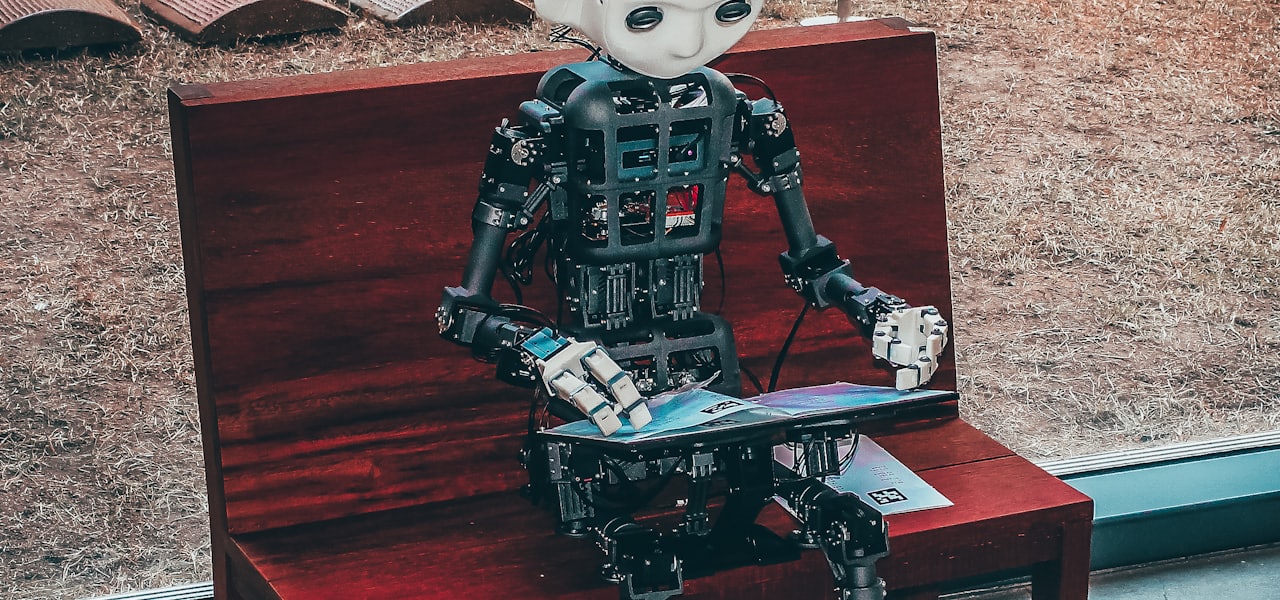
Smartglasses or smart glasses are eye or head-worn wearable computers. Many smartglasses include displays that add information alongside or to what the wearer sees. Alternatively, smartglasses are sometimes defined as glasses that are able to change their optical properties, such as smart sunglasses that are programmed to change tint by electronic means. Alternatively, smartglasses are sometimes defined as glasses that include headphone functionality. A pair of smartglasses can be considered an augmented reality device if it performs pose tracking. Superimposing information onto a field of view is achieved through an optical head-mounted display (OHMD) or embedded wireless glasses with transparent heads-up display (HUD) or augmented reality (AR) overlay. These systems have the capability to reflect projected digital images as well as allowing the user to see through it or see better with it. While early models can perform basic tasks, such as serving as a front end display for a remote system, as in the case of smartglasses utilizing cellular technology or Wi-Fi, modern smart glasses are effectively wearable computers which can run self-contained mobile apps. Some are handsfree and can communicate with the Internet via natural language voice commands, while others use touch buttons. Like other computers, smartglasses may collect information from internal or external sensors. It may control or retrieve data from other instruments or computers. In most cases, it supports wireless technologies like Bluetooth, Wi-Fi, and GPS. A small number of models run a mobile operating system and function as portable media players to send audio and video files to the user via a Bluetooth or WiFi headset. Some smartglasses models also feature full lifelogging and activity tracker capability. Smartglasses devices may also have features found on a smartphone. Some have activity tracker functionality features (also known as "fitness tracker") as seen in some GPS watches. == Features and applications == As with other lifelogging and activity tracking devices, the GPS tracking unit and digital camera of some smartglasses can be used to record historical data. For example, after the completion of a workout, data can be uploaded into a computer or online to create a log of exercise activities for analysis. Some smart watches can serve as full GPS navigation devices, displaying maps and current coordinates. Users can "mark" their current location and then edit the entry's name and coordinates, which enables navigation to those new coordinates. Although some smartglasses models manufactured in the 21st century are completely functional as standalone products, most manufacturers recommend or even require that consumers purchase mobile phone handsets that run the same operating system so that the two devices can be synchronized for additional and enhanced functionality. The smartglasses can work as an extension, for head-up display (HUD) or remote control of the phone and alert the user to communication data such as calls, SMS messages, emails, and calendar invites. === Security applications === Smart glasses could be used as a body camera. In 2018, Chinese police in Zhengzhou and Beijing were using smart glasses to take photos which are compared against a government database using facial recognition to identify suspects, retrieve an address, and track people moving beyond their home areas. === Sport applications === Smart glasses are used in sports like cycling, running, skiing, golf, tennis, or sailing, giving athletes real-time, heads-up data without looking down at the screen of a watch or smartphone. In 2025, Meta has announced a new partnership with sports eyewear brand Oakley. === Healthcare applications === Several proofs of concept for Google Glasses have been proposed in healthcare. In July 2013, Lucien Engelen started research on the usability and impact of Google Glass in health care. Engelen, who is based at Singularity University and in Europe at Radboud University Medical Center, is participating in the Glass Explorer program. Key findings of Engelen's research included: The quality of pictures and video are usable for healthcare education, reference, and remote consultation. The camera needs to be tilted to different angle for most of the operative procedures Tele-consultation is possible—depending on the available bandwidth—during operative procedures. A stabilizer should be added to the video function to prevent choppy transmission when a surgeon looks to screens or colleagues. Battery life can be easily extended with the use of an external battery. Controlling the device and/or programs from another device is needed for some features because of a sterile environment. Text-to-speech ("Take a Note" to Evernote) exhibited a correction rate of 60 percent, without the addition of a medical thesaurus. A protocol or checklist displayed on the screen of Google Glass can be helpful during procedures. Dr. Phil Haslam and Dr. Sebastian Mafeld demonstrated the first concept for Google Glass in the field of interventional radiology. They demonstrated the manner in which the concept of Google Glass could assist a liver biopsy and fistulaplasty, and the pair stated that Google Glass has the potential to improve patient safety, operator comfort, and procedure efficiency in the field of interventional radiology. In June 2013, surgeon Dr. Rafael Grossmann was the first person to integrate Google Glass into the operating theater, when he wore the device during a PEG (percutaneous endoscopic gastrostomy) procedure. In August 2013, Google Glass was also used at Wexner Medical Center at Ohio State University. Surgeon Dr. Christopher Kaeding used Google Glass to consult with a colleague in a distant part of Columbus, Ohio. A group of students at The Ohio State University College of Medicine also observed the operation on their laptop computers. Following the procedure, Kaeding stated, "To be honest, once we got into the surgery, I often forgot the device was there. It just seemed very intuitive and fit seamlessly." 16 November 2013, in Santiago de Chile, the maxillofacial team led by Dr.gn Antonio Marino conducted the first orthognathic surgery assisted with Google Glass in Latin America, interacting with them and working with simultaneous three-dimensional navigation. The surgical team was interviewed by ADN radio. In January 2014, Indian Orthopedic Surgeon Selene G. Parekh conducted the foot and ankle surgery using Google Glass in Jaipur, which was broadcast live on Google website via the internet. The surgery was held during a three-day annual Indo-US conference attended by a team of experts from the US and co-organized by Ashish Sharma. Sharma said Google Glass allows looking at an X-Ray or MRI without taking the eye off of the patient and allows a doctor to communicate with a patient's family or friends during a procedure. In Australia, during January 2014, Melbourne tech startup Small World Social collaborated with the Australian Breastfeeding Association to create the first hands-free breastfeeding Google Glass application for new mothers. The application, named Google Glass Breastfeeding app trial, allows mothers to nurse their baby while viewing instructions about common breastfeeding issues (latching on, posture etc.) or call a lactation consultant via a secure Google Hangout, who can view the issue through the mother's Google Glass camera. The trial was successfully concluded in Melbourne in April 2014, and 100% of participants were breastfeeding confidently. == Display types == Various techniques have existed for see-through HMDs. Most of these techniques can be summarized into two main families: "Curved Mirror" (or Curved Combiner) based and "Waveguide" or "Light-guide" based. The mirror technique has been used in EyeTaps, by Meta in their Meta 1, by Vuzix in their Star 1200 product, by Olympus, and by Laster Technologies. Various waveguide techniques have existed for some time. These techniques include diffraction optics, holographic optics, polarized optics, reflective optics, and projection: Diffractive waveguide – slanted diffraction grating elements (nanometric 10E-9). Nokia technique now licensed to Vuzix. Holographic waveguide – 3 holographic optical elements (HOE) sandwiched together (RGB). Used by Sony and Konica Minolta. Reflective waveguide – A thick light guide with single semi-reflective mirror is used by Epson in their Moverio product. A curved light guide with partial-reflective segmented mirror array to out-couple the light is used by tooz technologies GmbH. Virtual retinal display (VRD) – Also known as a retinal scan display (RSD) or retinal projector (RP), is a display technology that draws a raster display (like a television) directly onto the retina of the eye - developed by MicroVision, Inc. OLED microdisplays for near-eye applications (outdoor optical equipment, night vision glasses, ocular equipment for medical devices, augme
Open-source software security
Open-source software security is the measure of assurance or guarantee in the freedom from danger and risk inherent to an open-source software system. == Implementation debate == === Benefits === Proprietary software forces the user to accept the level of security that the software vendor is willing to deliver and to accept the rate that patches and updates are released. It is assumed that any compiler that is used creates code that can be trusted, but it has been demonstrated by Ken Thompson that a compiler can be subverted using a compiler backdoor to create faulty executables that are unwittingly produced by a well-intentioned developer. With access to the source code for the compiler, the developer has at least the ability to discover if there is any mal-intention. Kerckhoffs' principle is based on the idea that an enemy can steal a secure military system and not be able to compromise the information. His ideas were the basis for many modern security practices, and followed that security through obscurity is a bad practice. === Drawbacks === Simply making source code available does not guarantee review. An example of this occurring is when Marcus Ranum, an expert on security system design and implementation, released his first public firewall toolkit. At one time, there were over 2,000 sites using his toolkit, but only 10 people gave him any feedback or patches. Having a large amount of eyes reviewing code can "lull a user into a false sense of security". Having many users look at source code does not guarantee that security flaws will be found and fixed. == Metrics and models == There are a variety of models and metrics to measure the security of a system. These are a few methods that can be used to measure the security of software systems. === Number of days between vulnerabilities === It is argued that a system is most vulnerable after a potential vulnerability is discovered, but before a patch is created. By measuring the number of days between the vulnerability and when the vulnerability is fixed, a basis can be determined on the security of the system. There are a few caveats to such an approach: not every vulnerability is equally bad, and fixing a lot of bugs quickly might not be better than only finding a few and taking a little bit longer to fix them, taking into account the operating system, or the effectiveness of the fix. === Poisson process === The Poisson process can be used to measure the rates at which different people find security flaws between open and closed source software. The process can be broken down by the number of volunteers Nv and paid reviewers Np. The rates at which volunteers find a flaw is measured by λv and the rate that paid reviewers find a flaw is measured by λp. The expected time that a volunteer group is expected to find a flaw is 1/(Nv λv) and the expected time that a paid group is expected to find a flaw is 1/(Np λp). === Morningstar model === By comparing a large variety of open source and closed source projects a star system could be used to analyze the security of the project similar to how Morningstar, Inc. rates mutual funds. With a large enough data set, statistics could be used to measure the overall effectiveness of one group over the other. An example of such as system is as follows: 1 Star: Many security vulnerabilities. 2 Stars: Reliability issues. 3 Stars: Follows best security practices. 4 Stars: Documented secure development process. 5 Stars: Passed independent security review. === Coverity scan === Coverity in collaboration with Stanford University has established a new baseline for open-source quality and security. The development is being completed through a contract with the Department of Homeland Security. They are utilizing innovations in automated defect detection to identify critical types of bugs found in software. The level of quality and security is measured in rungs. Rungs do not have a definitive meaning, and can change as Coverity releases new tools. Rungs are based on the progress of fixing issues found by the Coverity Analysis results and the degree of collaboration with Coverity. They start with Rung 0 and currently go up to Rung 2. Rung 0 The project has been analyzed by Coverity's Scan infrastructure, but no representatives from the open-source software have come forward for the results. Rung 1 At rung 1, there is collaboration between Coverity and the development team. The software is analyzed with a subset of the scanning features to prevent the development team from being overwhelmed. Rung 2 There are 11 projects that have been analyzed and upgraded to the status of Rung 2 by reaching zero defects in the first year of the scan. These projects include: AMANDA, ntp, OpenPAM, OpenVPN, Overdose, Perl, PHP, Postfix, Python, Samba, and Tcl.
Inception (deep learning architecture)
Inception is a family of convolutional neural network (CNN) for computer vision, introduced by researchers at Google in 2014 as GoogLeNet (later renamed Inception v1). The series was historically important as an early CNN that separates the stem (data ingest), body (data processing), and head (prediction), an architectural design that persists in all modern CNN. == Version history == === Inception v1 === In 2014, a team at Google developed the GoogLeNet architecture, an instance of which won the ImageNet Large-Scale Visual Recognition Challenge 2014 (ILSVRC14). The name came from the LeNet of 1998, since both LeNet and GoogLeNet are CNNs. They also called it "Inception" after a "we need to go deeper" internet meme, a phrase from Inception (2010) the film. Because later, more versions were released, the original Inception architecture was renamed again as "Inception v1". The models and the code were released under Apache 2.0 license on GitHub. The Inception v1 architecture is a deep CNN composed of 22 layers. Most of these layers were "Inception modules". The original paper stated that Inception modules are a "logical culmination" of Network in Network and (Arora et al, 2014). Since Inception v1 is deep, it suffered from the vanishing gradient problem. The team solved it by using two "auxiliary classifiers", which are linear-softmax classifiers inserted at 1/3-deep and 2/3-deep within the network, and the loss function is a weighted sum of all three: L = 0.3 L a u x , 1 + 0.3 L a u x , 2 + L r e a l {\displaystyle L=0.3L_{aux,1}+0.3L_{aux,2}+L_{real}} These were removed after training was complete. This was later solved by the ResNet architecture. The architecture consists of three parts stacked on top of one another: The stem (data ingestion): The first few convolutional layers perform data preprocessing to downscale images to a smaller size. The body (data processing): The next many Inception modules perform the bulk of data processing. The head (prediction): The final fully-connected layer and softmax produces a probability distribution for image classification. This structure is used in most modern CNN architectures. === Inception v2 === Inception v2 was released in 2015, in a paper that is more famous for proposing batch normalization. It had 13.6 million parameters. It improves on Inception v1 by adding batch normalization, and removing dropout and local response normalization which they found became unnecessary when batch normalization is used. === Inception v3 === Inception v3 was released in 2016. It improves on Inception v2 by using factorized convolutions. As an example, a single 5×5 convolution can be factored into 3×3 stacked on top of another 3×3. Both has a receptive field of size 5×5. The 5×5 convolution kernel has 25 parameters, compared to just 18 in the factorized version. Thus, the 5×5 convolution is strictly more powerful than the factorized version. However, this power is not necessarily needed. Empirically, the research team found that factorized convolutions help. It also uses a form of dimension-reduction by concatenating the output from a convolutional layer and a pooling layer. As an example, a tensor of size 35 × 35 × 320 {\displaystyle 35\times 35\times 320} can be downscaled by a convolution with stride 2 to 17 × 17 × 320 {\displaystyle 17\times 17\times 320} , and by maxpooling with pool size 2 × 2 {\displaystyle 2\times 2} to 17 × 17 × 320 {\displaystyle 17\times 17\times 320} . These are then concatenated to 17 × 17 × 640 {\displaystyle 17\times 17\times 640} . Other than this, it also removed the lowest auxiliary classifier during training. They found that the auxiliary head worked as a form of regularization. They also proposed label-smoothing regularization in classification. For an image with label c {\displaystyle c} , instead of making the model to predict the probability distribution δ c = ( 0 , 0 , … , 0 , 1 ⏟ c -th entry , 0 , … , 0 ) {\displaystyle \delta _{c}=(0,0,\dots ,0,\underbrace {1} _{c{\text{-th entry}}},0,\dots ,0)} , they made the model predict the smoothed distribution ( 1 − ϵ ) δ c + ϵ / K {\displaystyle (1-\epsilon )\delta _{c}+\epsilon /K} where K {\displaystyle K} is the total number of classes. === Inception v4 === In 2017, the team released Inception v4, Inception ResNet v1, and Inception ResNet v2. Inception v4 is an incremental update with even more factorized convolutions, and other complications that were empirically found to improve benchmarks. Inception ResNet v1 and v2 are both modifications of Inception v4, where residual connections are added to each Inception module, inspired by the ResNet architecture. === Xception === Xception ("Extreme Inception") was published in 2017. It is a linear stack of depthwise separable convolution layers with residual connections. The design was proposed on the hypothesis that in a CNN, the cross-channels correlations and spatial correlations in the feature maps can be entirely decoupled. Training each network took 3 days on 60 K80 GPUs, or approximately 0.5 petaFLOP-days.
Textual case-based reasoning
Textual case-based reasoning (TCBR) is a subtopic of case-based reasoning, in short CBR, a popular area in artificial intelligence. CBR suggests the ways to use past experiences to solve future similar problems, requiring that past experiences be structured in a form similar to attribute-value pairs. This leads to the investigation of textual descriptions for knowledge exploration whose output will be, in turn, used to solve similar problems. == Subareas == Textual case-base reasoning research has focused on: measuring similarity between textual cases mapping texts into structured case representations adapting textual cases for reuse automatically generating representations.
Attempto Controlled English
Attempto Controlled English (ACE) is a controlled natural language, i.e. a subset of standard English with a restricted syntax and restricted semantics described by a small set of construction and interpretation rules. It has been under development at the University of Zurich since 1995. In 2013, ACE version 6.7 was announced. ACE can serve as knowledge representation, specification, and query language, and is intended for professionals who want to use formal notations and formal methods, but may not be familiar with them. Though ACE appears perfectly natural—it can be read and understood by any speaker of English—it is in fact a formal language. ACE and its related tools have been used in the fields of software specifications, theorem proving, proof assistants, text summaries, ontologies, rules, querying, medical documentation and planning. Here are some simple examples: Every woman is a human. A woman is a human. A man tries-on a new tie. If the tie pleases his wife then the man buys it. ACE construction rules require that each noun be introduced by a determiner (a, every, no, some, at least 5, ...). Regarding the list of examples above, ACE interpretation rules decide that (1) is interpreted as universally quantified, while (2) is interpreted as existentially quantified. Sentences like "Women are human" do not follow ACE syntax and are consequently not valid. Interpretation rules resolve the anaphoric references in (3): the tie and it of the second sentence refer to a new tie of the first sentence, while his and the man of the second sentence refer to a man of the first sentence. Thus an ACE text is a coherent entity of anaphorically linked sentences. The Attempto Parsing Engine (APE) translates ACE texts unambiguously into discourse representation structures (DRS) that use a variant of the language of first-order logic. A DRS can be further translated into other formal languages, for instance AceRules with various semantics, OWL, and SWRL. Translating an ACE text into (a fragment of) first-order logic allows users to reason about the text, for instance to verify, to validate, and to query it. == Overview == As an overview of the current version 6.6 of ACE this section: Briefly describes the vocabulary Gives an account of the syntax Summarises the handling of ambiguity Explains the processing of anaphoric references. === Vocabulary === The vocabulary of ACE comprises: Predefined function words (e.g. determiners, conjunctions) Predefined phrases (e.g. "it is false that ...", "it is possible that ...") Content words (e.g. nouns, verbs, adjectives, adverbs). === Grammar === The grammar of ACE defines and constrains the form and the meaning of ACE sentences and texts. ACE's grammar is expressed as a set of construction rules. The meaning of sentences is described as a small set of interpretation rules. A Troubleshooting Guide describes how to use ACE and how to avoid pitfalls. ==== ACE texts ==== An ACE text is a sequence of declarative sentences that can be anaphorically interrelated. Furthermore, ACE supports questions and commands. ==== Simple sentences ==== A simple sentence asserts that something is the case—a fact, an event, a state. The temperature is −2 °C. A customer inserts 2 cards. A card and a code are valid. Simple ACE sentences have the following general structure: subject + verb + complements + adjuncts Every sentence has a subject and a verb. Complements (direct and indirect objects) are necessary for transitive verbs (insert something) and ditransitive verbs (give something to somebody), whereas adjuncts (adverbs, prepositional phrases) are optional. All elements of a simple sentence can be elaborated upon to describe the situation in more detail. To further specify the nouns customer and card, we could add adjectives: A trusted customer inserts two valid cards. possessive nouns and of-prepositional phrases: John's customer inserts a card of Mary. or variables as appositions: John inserts a card A. Other modifications of nouns are possible through relative sentences: A customer who is trusted inserts a card that he owns. which are described below since they make a sentence composite. We can also detail the insertion event, e.g. by adding an adverb: A customer inserts some cards manually. or, equivalently: A customer manually inserts some cards. or, by adding prepositional phrases: A customer inserts some cards into a slot. We can combine all of these elaborations to arrive at: John's customer who is trusted inserts a valid card of Mary manually into a slot A. ==== Composite sentences ==== Composite sentences are recursively built from simpler sentences through coordination, subordination, quantification, and negation. Note that ACE composite sentences overlap with what linguists call compound sentences and complex sentences. ===== Coordination ===== Coordination by and is possible between sentences and between phrases of the same syntactic type. A customer inserts a card and the machine checks the code. There is a customer who inserts a card and who enters a code. A customer inserts a card and enters a code. An old and trusted customer enters a card and a code. Note that the coordination of the noun phrases a card and a code represents a plural object. Coordination by or is possible between sentences, verb phrases, and relative clauses. A customer inserts a card or the machine checks the code. A customer inserts a card or enters a code. A customer owns a card that is invalid or that is damaged. Coordination by and and or is governed by the standard binding order of logic, i.e. and binds stronger than or. Commas can be used to override the standard binding order. Thus the sentence: A customer inserts a VisaCard or inserts a MasterCard, and inserts a code. means that the customer inserts a VisaCard and a code, or alternatively a MasterCard and a code. ===== Subordination ===== There are four constructs of subordination: relative sentences, if-then sentences, modality, and sentence subordination. Relative sentences starting with who, which, and that allow to add detail to nouns: A customer who is trusted inserts a card that he owns. With the help of if-then sentences we can specify conditional or hypothetical situations: If a card is valid then a customer inserts it. Note the anaphoric reference via the pronoun it in the then-part to the noun phrase a card in the if-part. Modality allows us to express possibility and necessity: A trusted customer can/must insert a card. It is possible/necessary that a trusted customer inserts a card. Sentence subordination comes in various forms: It is true/false that a customer inserts a card. It is not provable that a customer inserts a card. A clerk believes that a customer inserts a card. ===== Quantification ===== Quantification allows us to speak about all objects of a certain class (universal quantification), or to denote explicitly the existence of at least one object of this class (existential quantification). The textual occurrence of a universal or existential quantifier opens its scope that extends to the end of the sentence, or in coordinations to the end of the respective coordinated sentence. To express that all involved customers insert cards we can write Every customer inserts a card. This sentence means that each customer inserts a card that may, or may not, be the same as the one inserted by another customer. To specify that all customers insert the same card—however unrealistic that situation seems—we can write: A card is inserted by every customer. or, equivalently: There is a card that every customer inserts. To state that every card is inserted by a customer we write: Every card is inserted by a customer. or, somewhat indirectly: For every card there is a customer who inserts it. ===== Negation ===== Negation allows us to express that something is not the case: A customer does not insert a card. A card is not valid. To negate something for all objects of a certain class one uses no: No customer inserts more than 2 cards. or, there is no: There is no customer who inserts a card. To negate a complete statement one uses sentence negation: It is false that a customer inserts a card. These forms of negation are logical negations, i.e. they state that something is provably not the case. Negation as failure states that a state of affairs cannot be proved, i.e. there is no information whether the state of affairs is the case or not. It is not provable that a customer inserts a card. ==== Queries ==== ACE supports two forms of queries: yes/no-queries and wh-queries. Yes/no-queries ask for the existence or non-existence of a specified situation. If we specified: A customer inserts a card. then we can ask: Does a customer insert a card? to get a positive answer. Note that interrogative sentences always end with a question mark. With the help of wh-queries, i.e. queries with query words, we can interrogate a text for details of the specified situation. If we specified: A
Record sealing
Record sealing is the process of making public records inaccessible to the public. In many cases, a person with a sealed record gains the legal right to deny or not acknowledge anything to do with the arrest and the legal proceedings from the case itself. Records are commonly sealed in a number of situations: Sealed birth records (typically after adoption or determination of paternity) Juvenile criminal records may be sealed Other types of cases involving juveniles may be sealed, anonymized, or pseudonymized ("impounded"); e.g., child sex offense or custody cases Cases using witness protection information may be partly sealed Cases involving trade secrets Cases involving state secrets == Filing under seal in US court == Normally, records should not be filed under seal without a court permission. However, FRCP 5.2 requires that sensitive text – like Social Security number, Taxpayer Identification Number, birthday, bank accounts, and children’s names – should be redacted off the filings made with the court and accompanying exhibits. A person making a redacted filing can file an unredacted copy under seal, or the Court can choose to order later that an additional filing be made under seal without redaction. Alternately, the filing party may ask the court’s permission to file some exhibits completely under seal. When the document is filed "under seal", it should have a clear indication for the court clerk to file it separately – most often by stamping words "Filed Under Seal" on the bottom of each page. Person making filing should also provide instructions to the court clerk that the document needs to be filed "under seal". Courts often have specific requirements to these filings in their Local Rules. == Difference from expungement == Expungement, which is a physical destruction, namely a complete erasure of one's criminal records, and therefore usually carries a higher standard, differs from record sealing, which is only to restrict the public's access to records, so that only certain law enforcement agencies or courts, under special circumstances, will have access to them. A record seal will greatly improve the chance of employment, as employers will not have access to damning records. There are occasions, like expungement, where one can truthfully state under oath that they have never been convicted before. Most of the time, a record seal has more relaxed requirements than an expungement. If an expungement is not allowed with a case, then sealing a record may be the best bet. Different states have different terms for what constitutes sealing of a record. == Cybersecurity incidents involving sealed records == Several cybersecurity incidents have demonstrated that sealed court documents are not always secure in practice, with vulnerabilities and data breaches exposing sensitive information. In January 2021, following the SolarWinds cyber attack, the U.S. Bankruptcy Court United States District Court for the District of Nevada announced that its Case Management/Electronic Case Files CM/ECF system had been potentially compromised. The judiciary stated that additional safeguards were being implemented to protect filings, and that the review of the incident and its impact was ongoing. Reports noted that the breach raised concerns about exposure of highly sensitive and sealed documents submitted through the CM/ECF system. In 2023, security researcher Jason Parker, following a tip from an activist, identified flaws in online court systems that exposed sealed records including confidential testimony and medical records through publicly accessible portals. In 2024, a cyber intrusion targeting attorneys in a civil case involving Representative Matt Gaetz led to the unauthorized access and leak of sealed depositions and related records. The breach exposed confidential testimony and financial records, some of which were later reported by news outlets, raising concerns about the security of electronically stored legal materials and the handling of sealed filings. In 2025, multiple reports confirmed that the federal judiciary's CM/ECF and PACER (law) filing system was compromised, exposing sealed indictments, confidential informant information, and other sensitive filings. Some courts temporarily reverted to paper-based filing to mitigate the risks of further disclosure. The FBI later confirmed that the breach had exposed sealed records, and investigators suspected foreign state actors were involved. == GAO publications referencing sealed records == Closed Criminal Plea and Sentencing Proceedings (1983) – Reviewed Department of Justice policies on closing plea and sentencing hearings. GAO noted that sealed transcripts should be unsealed once the reasons for closure no longer applied. Information on Plea Agreements and Settlements in Defense Procurement Fraud Cases (1992) – Examined outcomes of procurement fraud prosecutions. GAO observed that in some instances the results were sealed from public access. Military Recruiting: More Needs to Be Done to Better Screen Applicants and Detect Fraud (1999) – Investigated fraudulent enlistments in the armed forces. The report highlighted that sealed juvenile records often prevented recruiters from discovering prior offenses. Social Security Numbers: Governments Could Do More to Reduce Display in Public Records (2004) – Analyzed risks associated with SSN availability in state and local records. GAO pointed out that some categories of records, such as adoption proceedings, were sealed and less likely to expose identifiers. Social Security Numbers: Stronger Safeguards Needed to Protect Privacy (2005 testimony) – Testimony before Congress reiterating concerns over SSN exposure in public records, while noting that sealed categories (e.g., adoption) were exceptions. U.S. Supreme Court: Policies and Perspectives on Video and Audio Coverage of Appellate Court Proceedings (2016) – Surveyed appellate court policies on courtroom media coverage. The report acknowledged distinctions between public filings, confidential submissions, and sealed materials. Evictions: National Data Are Limited and Challenging to Collect (2024) – Examined nationwide eviction data. GAO reported that in some states eviction records may be sealed or expunged, limiting researchers' ability to compile datasets. DOD Fraud Risk Management: Enhanced Data and Collaboration Could Improve Efforts (2024) – Reviewed Department of Defense fraud-risk management. GAO noted that some adjudicative records in its dataset were sealed, restricting completeness of oversight data.
Image destriping
Image destriping is the process of removing stripes or streaks from images and videos without disrupting the original image/video. These artifacts plague a range of fields in scientific imaging including atomic force microscopy, light sheet fluorescence microscopy, and planetary satellite imaging. The most common image processing techniques to reduce stripe artifacts is with Fourier filtering. Unfortunately, filtering methods risk altering or suppressing useful image data. Methods developed for multiple-sensor imaging systems in planetary satellites use statistical-based methods to match signal distribution across multiple sensors. More recently, a new class of approaches leverage compressed sensing, to regularize an optimization problem, and recover stripe free images. In many cases, these destriped images have little to no artifacts, even at low signal to noise ratios.